
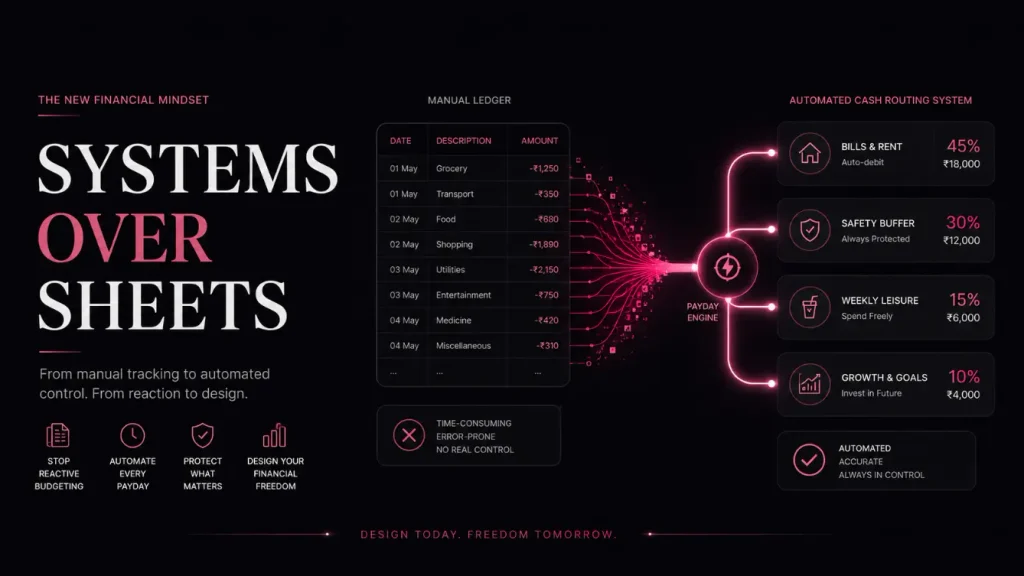
Selecting the right budgeting apps is often the first step young earners take to organize their finances, but mechanical systems outperform manual logs. This guide reveals why manual trackers lead to cognitive fatigue and how an automated cash-management pipeline secures your check on Day 1. By replacing constant decision-making with structured bank vaults, you can stop entry leaks and build a stress-free financial routine. Discover how to transition from tedious logging to a set-and-forget framework that runs in the background of your busy lifestyle.
To gain immediate control over your cash flow, you must stop focusing on post-mortem transaction logs and instead establish an automated distribution process on payday. By dividing your take-home pay immediately into isolated accounts for bills, safety runway, and guilt-free spending, you eliminate the daily willpower struggle of managing a single bank account. This proactive division ensures that your savings are locked in place and your expenses are pre-funded before you begin discretionary spending.
Earning a starting salary in a major Indian metropolitan city like Bangalore, Mumbai, or Pune is a significant milestone, yet many professionals find their accounts depleted within days, which often drives them to download popular budgeting apps. They log in with high expectations of becoming financially disciplined, only to realize a few weeks later that their banking balance is still hitting zero before the next credit. This common frustration occurs because traditional methods solve the wrong problem.
5 Reasons Why Budgeting Apps Keep Failing You (and the Payday Solution)
The Trap of the Digital Ledgers: Why Traditional Budgeting Apps Cause Decision Fatigue
Most budgeting apps operate on the principle of manual ledger tracking. They ask you to categorize every single transaction, from the ₹50 auto-rickshaw ride to the cup of filter tea at the corner shop. While this transactional tracking behaves like a useful financial mirror, it requires constant maintenance.
When a busy week hits and logging a taxi ride or a lunch expense feels like a chore, we stop opening these budgeting apps altogether. The cognitive friction of recording past transactions is too high, leading to tracking fatigue. This post-mortem tracking behavior is why traditional budgeting apps feel like homework instead of financial empowerment.
Unlike automated cash flow systems, manual budgeting apps require you to make separate, active decisions for every rupee you spend. Every transaction prompts a fresh micro-debate in your head: Can I afford this? Which budget category does this fall under? Should I dip into my savings for this meal? This constant evaluation depletes your mental energy, leaving you vulnerable to emotional spending when your willpower is lowest.
What Most Young Earners Get Wrong About Financial Control in India
When early-career professionals notice their money disappearing, they install three different budgeting apps expecting software to fix their financial habits. The real problem is not a lack of tracking; it is a structural vulnerability inside their primary bank account.
Leaving your entire monthly salary in a single bank account makes it look like a unified pool of money. When you look at your bank balance and see ₹45,000, you feel wealthy. You forget about the PG rent due next week, the upcoming electricity bill, the student loan payment, or the subscription renewals. You spend based on what is currently in the account, only to find yourself short when the non-negotiables are debited.
Furthermore, standard financial advice often tells young earners to invest in equities or mutual funds immediately on Day 1. While long-term investing is critical, locking away too much cash in volatile equity segments leaves you without liquid runway. When an unbudgeted cost arises, such as a PG security deposit or a clinical bill, you are forced to break your investments at a loss or borrow cash from family. You need a cash pipeline that balances liquid security with growth.
Tracking vs. Controlling: The Core Difference
Before you can build wealth, you must understand the distinction between tracking your cash and controlling it.
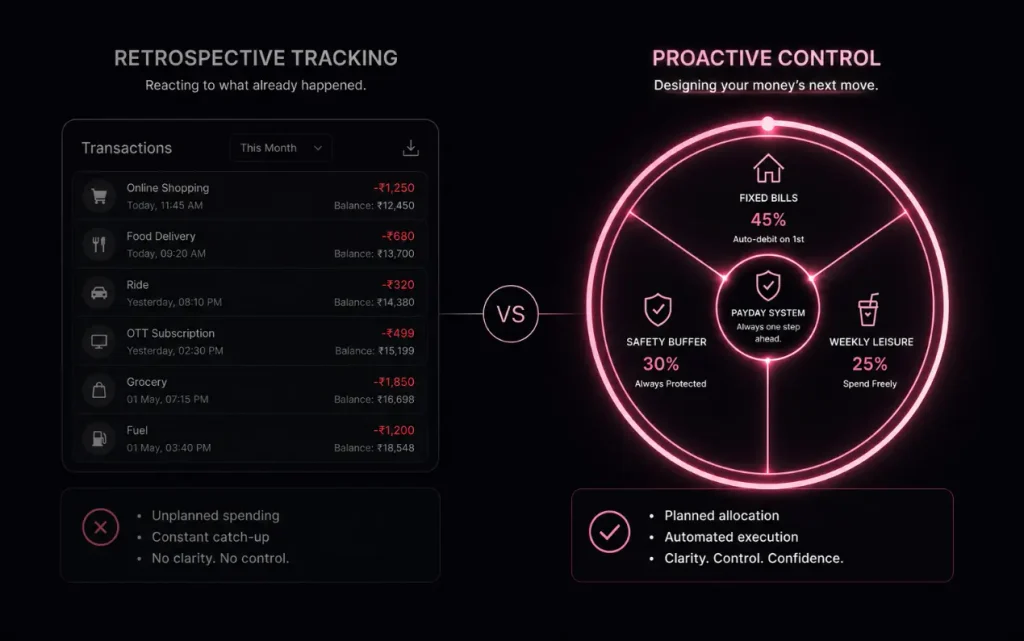
- Tracking is historical. It looks backward. It answers the question: “What happened to my money?” It is like reading an autopsy report of your bank account at the end of the month.
- Controlling is proactive. It looks forward. It answers the question: “What should happen to my money before I spend it?” It sets the boundaries beforehand so that you do not need to check your balance before every transaction.
While typical budgeting apps focus on where your money went, a money system focuses on where your money should go before you spend a single rupee. It is the difference between diagnosing a leak and designing a plumbing layout that prevents leaks from ever occurring. In short, you do not need another set of budgeting apps to track your mistakes; you need a process that runs in the background of your life.
Introducing the Money System: The Power of Payday Splitting
A money system is a structured pipeline that routes your income automatically the moment it lands. Instead of managing a single bank account, you divide your cash flow into visual containers or discrete bank accounts, each dedicated to a specific financial job.
By moving away from budgeting apps, you can construct a series of automated transactions that execute on the very day your salary is credited. This ensures that your fixed living costs, your safety reserves, and your savings goals are funded first. What remains is your discretionary spending pool, which you are free to spend to the last rupee without guilt or worry.
This automated split is something that ordinary budgeting apps cannot enforce because they lack direct control over your bank partitions. By automating this partitioning using modern Indian banking features—such as bank-level pockets, multi-account routing, and automated e-mandates—you eliminate the daily temptation to spend your rent money on leisure activities.
The Payday Partitioning Framework
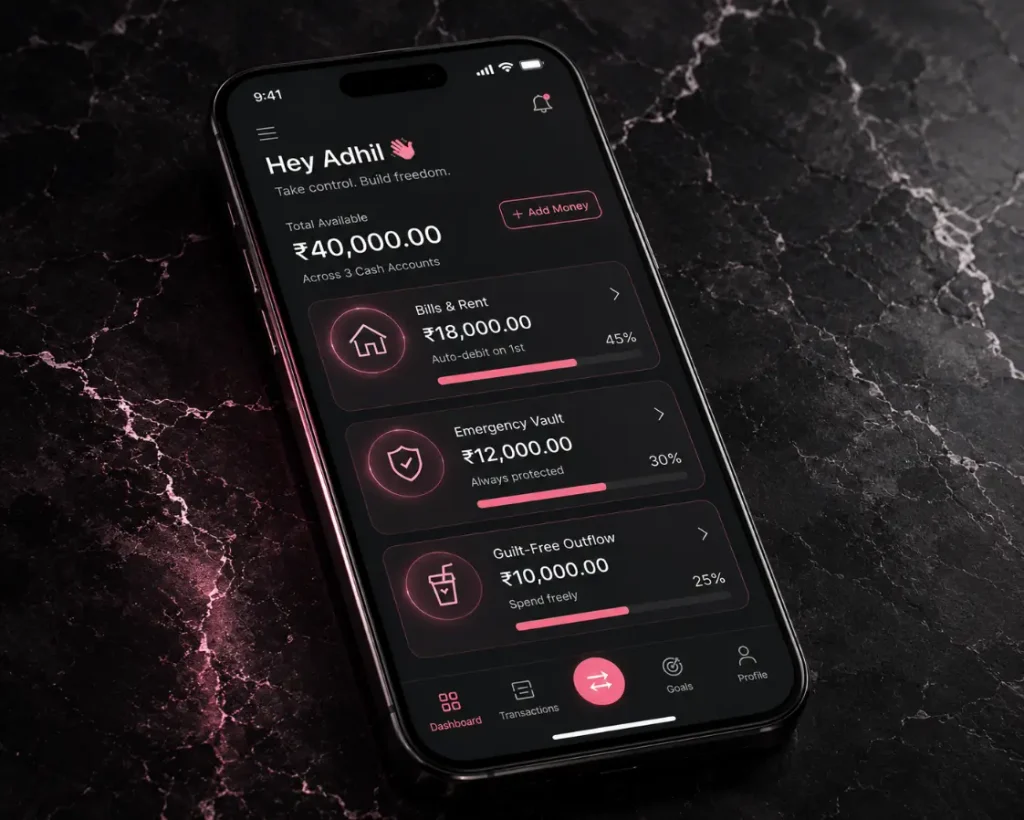
The architecture of a behavioral cash-routing system relies on three distinct vaults, each serving a unique function:
- The Core Living Vault (Fixed Costs): This vault holds standard, non-negotiable living costs. This includes rent or PG fees, transit, groceries, utility bills, and insurance premiums. This money is committed on Day 1 and should be automated through auto-debits.
- The Emergency Vault (Liquid Runway): This vault acts as your shield. Before you allocate any money to long-term mutual funds or stock markets, you must build a liquid buffer. This vault should hold at least two months of basic living costs. It stays liquid in an instant-access sweep-in account or a secondary high-interest savings account.
- The Guilt-Free Outflow Vault (Discretionary Cash): This is the cash you use for dinners, movie outings, shopping, subscription services, and hobbies. This pool is strictly isolated from your core living expenses. Once this wallet hits zero, your discretionary spending stops until the next pay cycle.
Real-World Scenarios: How a Young Indian Professional Allocates Cash
To see how this framework functions in practice, let us explore three illustrative scenarios based on starting salaries in tier-1 and tier-2 Indian cities. These scenarios show how young professionals can structure their cash flow without relying on manual ledgers.
Scenario 1: Earning ₹30,000 Net (First-Job Earner in a Shared PG in Pune)
- Objective: Stay stable, build a basic buffer, and cover essential PG costs.
- Illustrative example: Rohan is a junior analyst earning ₹30,000 net monthly take-home. He lives in a shared PG in Pune, where his monthly rent includes basic electricity and internet.
Rohan tried several budgeting apps but kept forgetting to log his auto-debited subscriptions, which threw off his monthly spreadsheet. Instead of tracking, Rohan set up a dual-account system. Here is his illustrative monthly partition:
| Partition | Purpose | Allocation (₹) | Allocation % |
| Core Living | PG Rent, food mess, local transit | 14,000 | 46.7% |
| Emergency Vault | Starting liquid reserve | 3,000 | 10.0% |
| Savings Goal | Post-buffer retirement/investing fund | 3,000 | 10.0% |
| Guilt-Free Outflow | Social outings, chai, streaming services | 8,000 | 26.6% |
| Remaining Buffer | Casual buffer in primary account | 2,000 | 6.7% |
Under this allocation, Rohan immediately routes ₹14,000 to cover his PG rent and transport expenses. He moves ₹3,000 to a secondary savings account that acts as his emergency reserve. Another ₹3,000 is routed via auto-debit to a mutual fund SIP. He leaves ₹10,000 in his primary account. Of this, ₹8,000 is his flexible discretionary pool for the month, and ₹2,000 remains as a cash buffer to prevent accidental overdrafts. He tracks his daily spending by checking his primary balance, ensuring he stays within the ₹8,000 limit.
Scenario 2: Earning ₹45,000 Net (Software Engineer in a Flat-Share in Bangalore)
- Objective: Pay off education EMIs, build a robust emergency buffer, and manage independent food bills.
- Illustrative example: Ananya is a software engineer earning ₹45,000 net monthly. She rents a room in a 2BHK flat-share in Bangalore, commutes via metro, and has a monthly student loan repayment.
Ananya deleted her budgeting apps because she realized they did not stop her from spending her emergency fund on weekend trips. To fix this, she isolated her funds using distinct digital vaults. Here is her illustrative allocation:
| Partition | Purpose | Allocation (₹) | Allocation % |
| Core Living | Flat rent, maintenance, metro pass, groceries | 19,000 | 42.2% |
| Debt Obligations | Student loan EMI | 6,500 | 14.4% |
| Emergency Vault | Building a three-month runway | 5,000 | 11.1% |
| Savings Goal | Mutual fund SIP and tax-saving deposits | 5,000 | 11.1% |
| Guilt-Free Outflow | Dining out in Indiranagar, shopping, travel | 8,000 | 17.8% |
| Remaining Buffer | Miscellaneous buffer in primary card | 1,500 | 3.3% |
Ananya automates the transfer of ₹19,000 to her flat-share and utility billing account. Her student loan EMI of ₹6,500 is auto-debited on the third of the month from her Core Living vault. On payday, she routes ₹5,000 to her emergency sweep-in deposits and ₹5,000 to her investment SIP. The remaining ₹9,500 is left in her primary account: ₹8,000 is swept to a second card for discretionary outflows, and ₹1,500 is kept as a floating buffer. By keeping her shopping card separate from her bill-paying card, she never risks missing an EMI.
Scenario 3: Earning ₹60,000 Net (Marketing Associate in a Rental in Gurgaon)
- Objective: Support parents, pay higher rent, and maximize investment goals.
- Illustrative example: Vikram is a marketing associate earning ₹60,000 net take-home in Gurgaon. He rents an independent flat, commutes via rapid metro, and sends a portion of his income to his parents monthly.
For Vikram, using budgeting apps was a weekly source of guilt rather than a tool for financial freedom. He replaced manual logging with an automated distribution pipeline. Here is his illustrative partition:
| Partition | Purpose | Allocation (₹) | Allocation % |
| Core Living | Rent, cook, electricity, internet, commute | 24,000 | 40.0% |
| Debt Obligations | Credit card/gadget EMI repayments | 3,000 | 5.0% |
| Family Support | Monthly credit sent to parents | 8,000 | 13.3% |
| Emergency Vault | Dynamic emergency buffer | 7,000 | 11.7% |
| Savings Goal | High-growth equity SIP and recurring deposits | 8,000 | 13.3% |
| Guilt-Free Outflow | Weekend social visits, clothing, entertainment | 8,000 | 13.3% |
| Remaining Buffer | Float buffer in salary account | 2,000 | 3.4% |
Vikram’s corporate payday occurs on the last working day of the month. On the first morning, ₹24,000 is swept to his dedicated billing account where his rent and utility auto-debits reside. He automatically sends ₹8,000 to his parents’ account and ₹3,000 for his laptop EMI. He saves ₹7,000 in his Emergency Vault and routes ₹8,000 to his investment accounts. The remaining ₹10,000 in his primary salary account contains ₹8,000 for weekly leisure activities and a ₹2,000 safety float. If his leisure card runs dry, he stops dining out for the month, keeping his primary assets secure.
Common Pitfalls That Can Break Your Salary Allocation Pipeline
While an automated cash system works reliably, there are specific behavioral traps to avoid:
- Violating the Emergency Vault: This buffer is only for true crises, such as job loss, critical house repairs, or urgent clinic visits. It is not a secondary shopping cache or a fund for holiday bookings. If you spend this buffer, you must pause your discretionary leisure payments until the vault is fully restored.
- Neglecting Subscription Leaks: Small recurring debits—such as entertainment streaming platforms, fitness packages, and professional portals—can quietly drain your billing accounts. Review your automated mandates once every quarter to cancel services you no longer use.
- Returning to Manual Logs Out of Habit: One major pitfall that young earners encounter is returning to budgeting apps when their automated allocations go out of sync. When cash flow shifts, do not waste time logging small charges; update your payday routing percentages at the bank level.
- Ignoring Debt Priority: If you have high-interest credit card debt or personal loans, your surplus funds should be routed to clear these liabilities before you fund long-term equity SIPs. High-interest debt is a severe financial drag that offsets standard market gains.
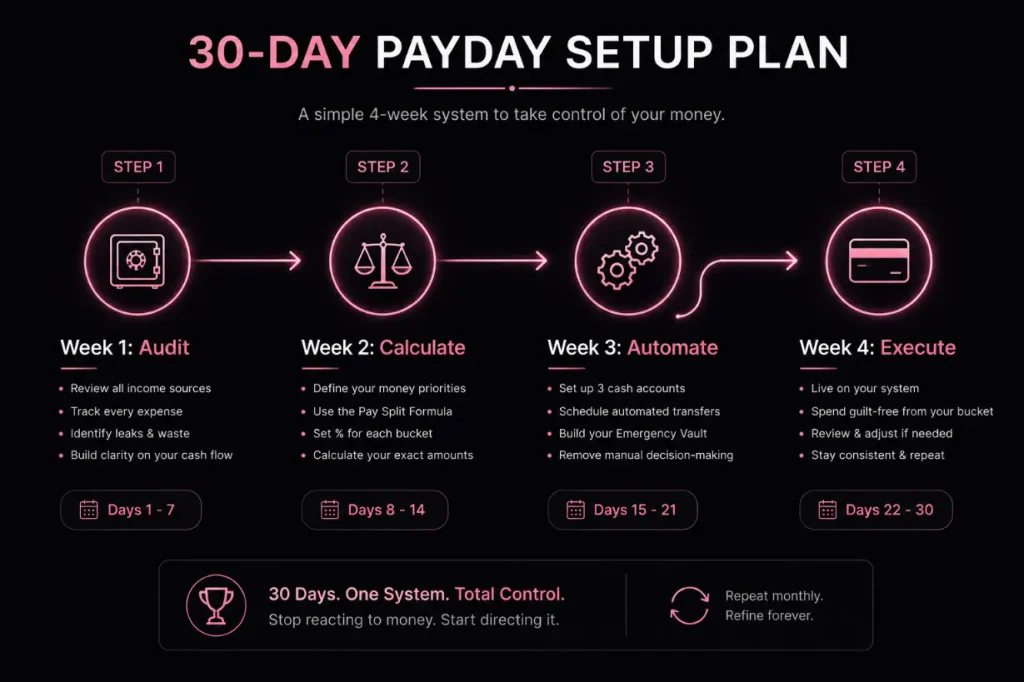
Your 30-Day Payday Automation Action Plan
Transitioning from manual tracking to an automated money system takes planning. Here is a week-by-week blueprint to build your structure:
Week 1: Audit and Vault Setup
Verify your actual take-home credit. Open a secondary bank account (or utilize digital pockets within your current bank) to act as your Core Living Vault. Identify a high-yield sweep-in deposit account to serve as your Emergency Vault. the user-facing tools page to explore custom financial worksheets and tools you can use.
Week 2: Calculate Your Baseline allocations
Calculate your fixed monthly commitments (rent, transport, debt EMIs, utilities). This forms your baseline fixed requirement. The remainder of your income is your discretionary pool and your savings target. Check out the latest digital tools on the Toolsell Shop Page to download a clean spreadsheet template that helps you set these splits, or use the Ultimate Financial Calculators to model your balances.
Week 3: Set Up Automated Mandates and Swings
Configure e-mandates and auto-debits to trigger on the first day of your salary cycle. Route your fixed payments to your Core Living Vault and your target savings to your investment portals. Instead of tracking details in budgeting apps, verify that your automatic routing rule is executing correctly at the start of each month.
Week 4: The Outflow Test
Route your discretionary leisure allowance (the guilt-free pool) to a separate digital wallet, debit card, or payment app. Spend strictly from this isolated pool. For the final week of the month, verify that your core bills remain fully paid by your Core Living Vault, leaving you with zero financial anxiety.
Frequently Asked Questions
Can budgeting apps help you build long-term wealth?
No, most budgeting apps only record past transactions without modifying your spending behavior. They tell you where your money has already gone, acting as a historical guide. To build wealth, you need a forward-looking allocation framework that automates your investments on payday before you have the chance to spend the capital.
Thus, while budgeting apps are useful for auditing past leaks, they do not build wealth. True financial freedom is achieved by building a predictable, mechanical system that isolates savings from spendable assets.
What happens when you cannot control your monthly expenses?
When you lack control, your spending adapts to reflect your available balance. This issue is known as lifestyle inflation. Without clear boundaries between your PG rent, utility funds, and social accounts, you will naturally spend your bill money on immediate leisure, leading to debt cycles.
How many bank accounts do I need for a payday money system?
You generally require two to three bank accounts or digital sub-pockets. One primary account serves as your salary credit hub and discretionary outflow card, a secondary account houses your core bills and rent deposits, and third, a liquid sweep-in account stores your emergency reserves safely.
Is the 50/30/20 budget rule practical for young earners in Indian metro cities?
The generic rule (50% needs, 30% wants, 20% savings) is often challenging for entry-level professionals in high-rent areas like Mumbai or Bangalore. A behavior-first approach is better: calculate your actual non-negotiable living costs first, set a modest savings target, and allocate the remainder to guilt-free leisure.
What is the best way to handle debt payments on a starting salary?
You should prioritize paying off high-interest debt, such as credit card balances and personal loans, before making significant long-term investments. Automate these EMI credits so they exit your Core Living Vault on Day 1 of your pay cycle, preventing late fees and interest buildup.
Why does willpower fail in financial planning?
Willpower is a finite cognitive resource that is depleted by daily stress, work decisions, and constant exposure to digital shopping advertisements. Relying on restraint to curb spending means making dozens of difficult decisions daily. An automated system reduces decision fatigue by making the right choice your default path.
Mastering Your Cash Flow
A money system is not about restricting your lifestyle; it is about creating peace of mind. By automating your accounts, you ensure that your obligations are met and your future is funded the moment your paycheck lands.
Transitioning from the manual tracking found in budgeting apps to an automated cash pipeline is a mindset shift. It moves you from looking backward with regret to looking forward with clarity and confidence. The practical mechanics of building this structure are explained in the workbook:
You Don’t Need More Money Advice: You Need a Money System by P. Adhil Khan.
This guide acts as a deeper practical resource for readers who want to build a repeatable money system rather than collect more isolated financial advice. The handbook details the step-by-step 30-day blueprints to clean up your bank accounts, structure your emergency reserves, and set up automated cash-routing pipelines that run in the background of your starting career.
If you are tired of downloading budgeting apps only to delete them a month later, it is time for a system. You can explore the complete playbook and claim your founding toolkits directly on the Toolsell Product Page. If you prefer mobile reading or physical print formats, you can find the title on the Amazon Kindle Store and Amazon Paperback Listings, or obtain the digital handbook on Gumroad.